TABLE OF CONTENTS
Preamble
- new school file set up
- synchronisation processes
- synchronisation troubleshooting
The following information has been provided by the Daymap team and was correct at the time of publication. Please check the Daymap documentation for any changes to the process. Please contact them for any support required in the set up in this system, as Tes consultants are not able to advise.
While Tes takes all care to ensure any mention to the other system is correct and up to date, it is the user's responsibility to check with the other system prior to an initial sync. If the user becomes aware of any changes to the other system, we would very much appreciate this feedback
Type of sync
Which data is sent to the other system?
Note that Tes builds many excellent features to help users build high quality timetables, and while these features can be sent onto the other system through the synchronisation process, not all systems have built the capability on their end to receive/display these feature
| Tes Timetable feature | Notes on feature | Is this feature received by the other system? | Other notes |
| Bell times | Bell times as per the Grid structures | No | |
| Campuses | Campuses and their associated rooms | Yes | |
| Classes | Class code, GUID, Faculty, Course Name, Assigned teacher | Yes | |
| Class lists | Yes | ||
| Composite classes (linked classes) | One teacher teaching more than one class at the same time | Yes | |
| Duty roster | Yes | ||
| Faculty data | Yes | ||
| Grid structure codes | Yes | ||
| Multi-file | Two (or more) timetable files | Unsure | |
| Multi-grid | Multiple grids with different bell times | Unsure | |
| On-call roster | Yes | ||
| Priority classes | The priority class that shows on students' timetables where they have class clashes | Yes | |
| Room data | Room Code | Yes | |
| Rotation classes | Classes from particular rotations | Yes | |
| RTO roster | Yes | ||
| Student data | Student Code, Name, Preferred name, Year level, Gender, Email | Yes | |
| Study roster | Study classes, staffing and rooming roster | Yes | |
| Sub-classes | |||
| Teacher data | Teacher Code, Name, Preferred name, Faculty, Gender, GUID | Yes | |
| Teacher days off (Unavailable) | No | ||
| Timetable data | Yes | ||
| Two (or more) rooms at once | No | ||
| Two (or more) teachers at once | No | ||
| Year levels (non-numeric) | Year levels such as SPT, LSUP, ROLL, Yr9+10, etc... | Yes |
Steps to Synchronise data
Step 1: Check if any Daymap set-up is required
Step 2: Configure the Timetable file
Go to File > Synchronise > Configure
Select the ‘Sync’ sub-tab
Click the '+' and select "Daymap " from the dropdown
Go to the ‘Connection’ sub-tab
Ensure that “Daymap 65” is selected in the top-right corner
Input your credentials. Daymap will provide you with the Daymap Server, Username, School code and Password.
Proxy: Not usually required. See your school network administrator if a proxy message appears after
Testing connection.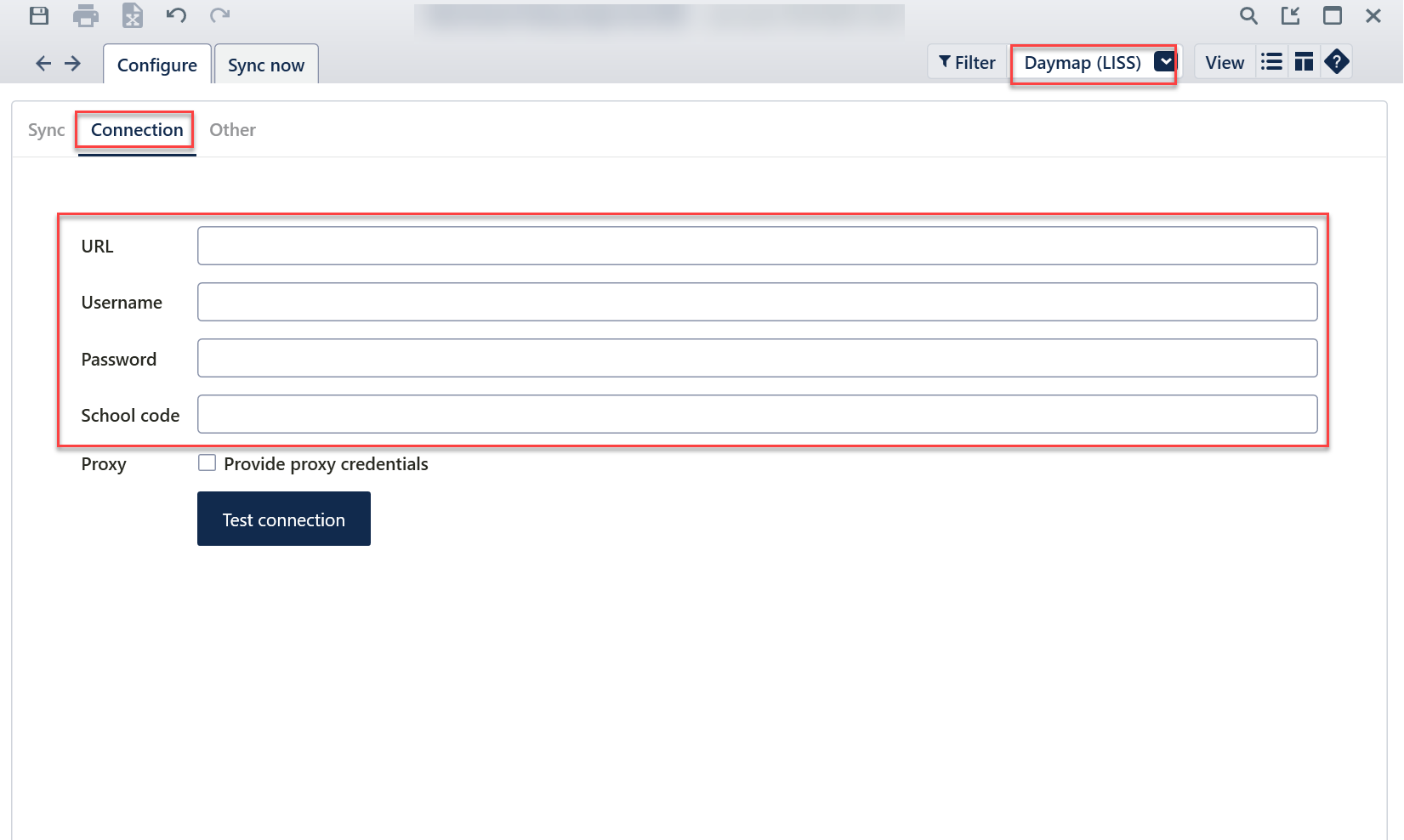
- Go to the ‘Other' sub-tab and change any options to your preference.
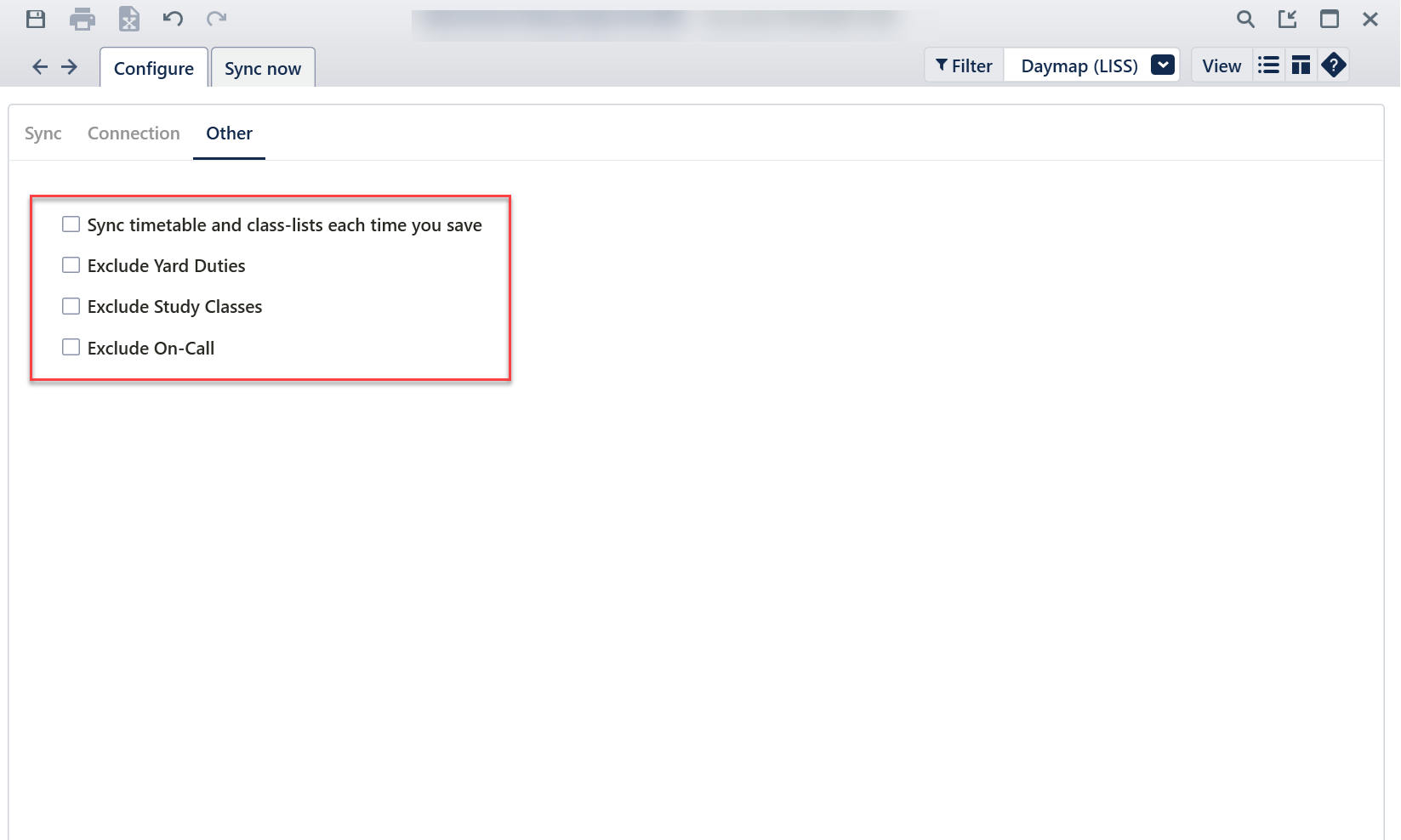
| Option | Details |
Sync timetable & class lists every time you save | This will send only the timetable and class membership data to Daymap each time you save the file |
Exclude Yard duties | When ticked, Yard duties will be ignored for syncing purposes |
| Exclude Study classes | When ticked, Study classes will be ignored for syncing purposes |
| Exclude On-calls | When ticked, on-calls will be ignored for syncing purposes |
Which years? | This option allows you to select the specific year levels to send to Daymap. Please leave all of the year levels un-ticked if you want to send everything. Note. This function will only appear if the timetable file has the Multi-grid function enabled. |
Step 3: Perform the sync
Basic Sync
To perform a basic sync:
Go to File > Synchronise > Sync Now and select the ‘Basic’ sub-tab
Ensure “Daymap” is selected from the dropdown in the top-right corner
- Input the date range you wish to update the Daymap data in, and select the rotation you wish to sync
Click “Go” to sync
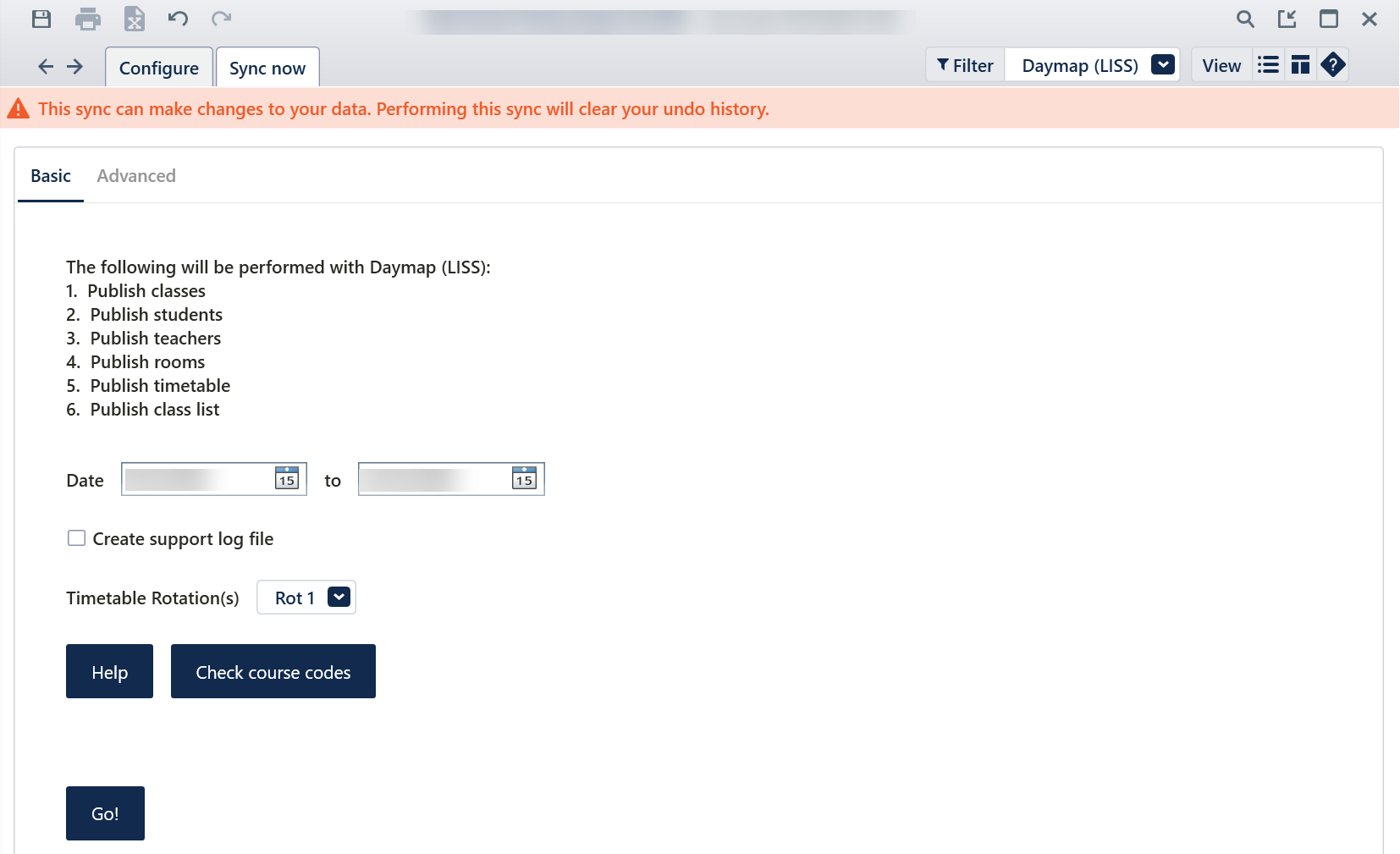
Check course codes: This button checks that classes with the same course codes but different subject names are flagged as Daymap does not differentiate between them and applies the first subject name it sees for all classes with that course code. E.g. 12ENG1 - English and 12ENGA - Engineering. Course code for both classes is '12ENG' and Daymap could label both as either 'English' or 'Engineering'.
Advance Sync
Advance sync is used to publish specific parts of your data to Daymap. An advanced sync also allows you to download from Daymap as per the screenshot below.
To perform an advanced sync:
Go to File > Synchronise > Sync Now, and select the ‘Advance’ sub-tab
Ensure “Daymap” is selected from the dropdown in the top-right corner
Select which data you wish to sync with Daymap
Input the date range you wish to update the Daymap data in, and select the rotation you wish to sync
'Rotation' Select the rotation to sync to the Daymap server: all rotations can also be selected
Click “Go” to sync
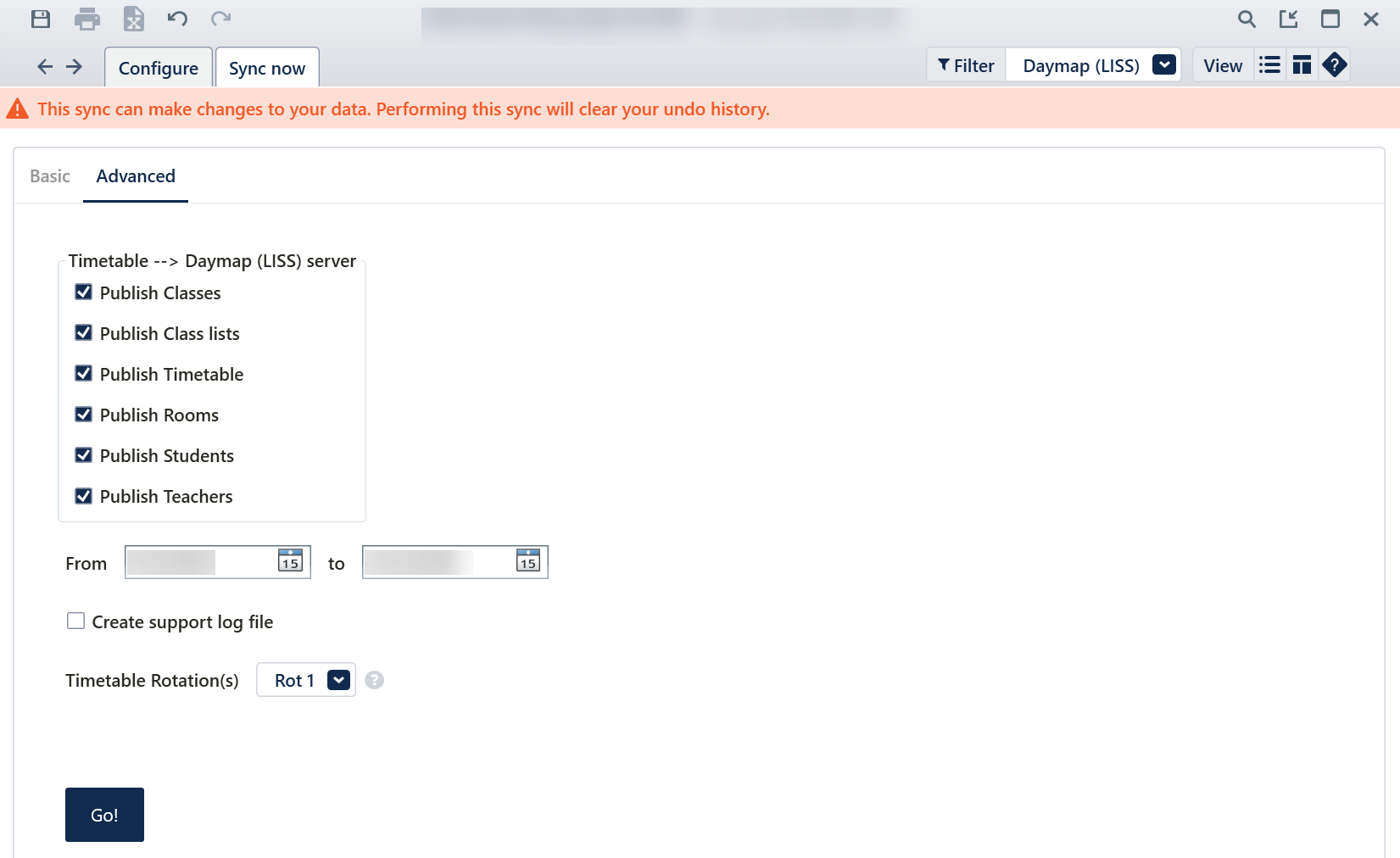
Create support log file: Occasionally, Tes specialists may ask you to perform a sync and tick this box, which will create a text file in the same location as the timetable file. This file can be sent to Tes to help with troubleshooting.Was this article helpful?
That’s Great!
Thank you for your feedback
Sorry! We couldn't be helpful
Thank you for your feedback
Feedback sent
We appreciate your effort and will try to fix the article